

10 Disadvantages of solar panels. What to consider before you buy
This article is intended to help homeowners understand the practical considerations before investing in solar PV. It is general information, not financial, legal, planning or technical advice for a particular property. Every home is different. A proper assessment should be based on the individual property, energy use and proposed system.
20/07/2026
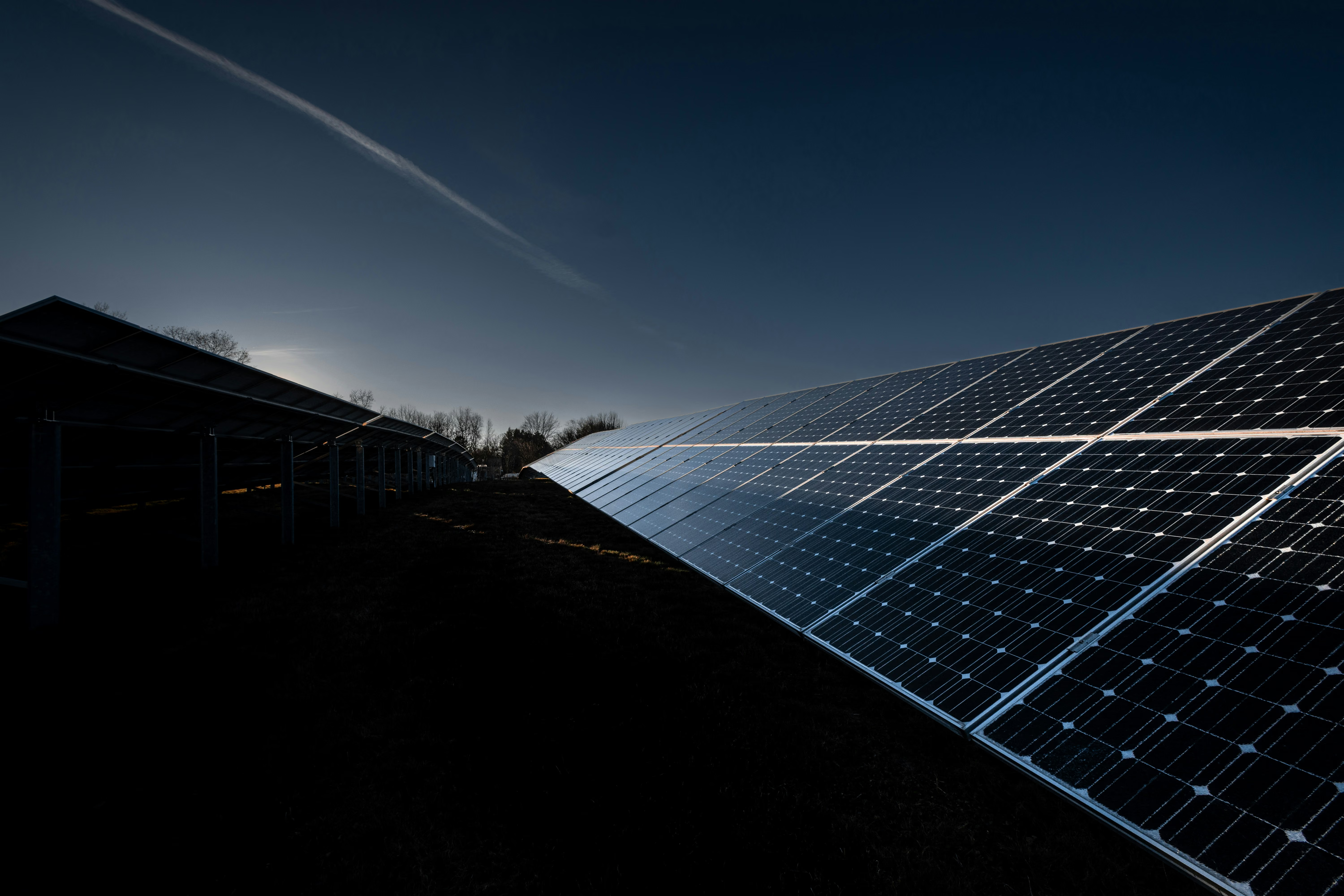
Solar panels may not suit every home. Some issues can be managed, others may be costly to address, and some cannot be resolved. We will highlight any significant drawbacks. If solar isn't right for your situation, we want you to know before you buy.
The upfront cost is significant
Let's start with the obvious one. Solar panels require a significant upfront investment, which is unavoidable. Financing options and support schemes may help, but you remain responsible for equipment and installation costs.
Your financial outcome depends on your property, electricity usage, system size, installation cost, battery storage, and how you manage surplus electricity. Be wary of anyone providing exact savings or payback periods without first assessing your property. If installing solar requires borrowing beyond your comfort level, it may be best to wait.
If you rent, the decision isn't entirely yours
If you rent, you generally cannot install solar panels without approval. Landlord approval is required, and financial arrangements can be complex since costs and benefits may not align between parties.
A landlord may find solar worthwhile as a long-term investment, but this decision requires discussion between landlord and tenant. If you are renting, your first question should be “Does my landlord want to explore solar?” If the answer is no, there is little an installer can do.
If you're moving soon, the financial case changes
Solar is a long-term investment. If you plan to move within a few years, consider whether you will benefit enough from the system before relocating. Solar may enhance property value or appeal, but you may not recover all costs in the sale price. There is no universal payback period for solar installations.
Your result depends on your roof, your electricity consumption, the system you install, how much electricity you use yourself, export payments and future energy prices. If you plan to move soon, have a professional assess your specific situation.
Your roof might simply not be suitable
Solar panels require a suitable location. Roof orientation, angle, available space, and shading all affect electricity generation. A well-positioned, relatively unshaded roof is the straightforward case. A heavily shaded roof is more complicated.
If your roof needs replacing soon, installing solar may create additional problems, as you would need to remove the system for major roof work. North-facing roofs are not automatically unsuitable. Suitability depends on the property and system design, and less-than-ideal roof areas can still provide useful generation. Have a professional assess your roof rather than assuming it's suitable.
Solar produces most of its electricity during daylight
Consider this before purchasing solar. Panels generate electricity during daylight, peaking around midday. Many households use more electricity in the morning, evening, and overnight. If you are often away during the day, you may not use all the electricity your panels produce as it is generated.
You can export surplus electricity to the grid, and eligible small-scale generators may receive payments through the Smart Export Guarantee (SEG). Tariffs and terms vary by supplier. Alternatively, a battery can store surplus electricity for later use. Neither option is automatically best. Consider how much electricity you use during solar generation hours and whether storing more would benefit your household. Each option involves a trade-off:
No battery: lower upfront cost, but you may export more solar electricity.
Battery: higher upfront cost, but you can store more of your solar generation for later use.
Winter is genuinely poor for solar generation
This limitation cannot be resolved through system design. Solar panels generate electricity year-round, including on cloudy days, but UK solar generation is highly seasonal. Winter brings shorter days and lower solar irradiation, so panels produce significantly less electricity during these months compared to spring and summer.
This timing is not ideal, as solar generation peaks when daylight is abundant, but household electricity needs often increase during the darker months. A larger system, improved design, or battery storage can help manage your electricity use, but cannot make winter days as productive as summer days.
Your roof needs to be in good condition
This factor is often overlooked. Solar panels are intended to remain on your roof for many years. If your roof is nearing the end of its useful life, installing solar panels first could lead to costly issues later. You may need to remove and reinstall panels before and after major roof work, which adds cost. If your roof requires significant repair or replacement, address this before installing solar. While this may increase initial costs, it can prevent unnecessary expenses later.
The panels are not the only part of the system
Many people think of solar panels as the entire installation, but a typical solar PV system also includes equipment such as an inverter and electrical protection devices. A battery system adds more components. Each part has its own warranty, expected lifespan, and replacement cost.
Panels are designed for long-term use, but other components may need maintenance or replacement sooner, depending on equipment, usage, and conditions. We recommend asking your installer: “What happens when a major component reaches the end of its useful life?” and “What replacement costs should I expect over the system’s lifetime?” A thorough solar assessment should consider the entire expected ownership period, not just the first year.
The installer matters long after the panels are fitted
This is a critical consideration. Solar is a long-term investment, so do not choose an installer based only on the cheapest quote, the highest claimed savings or the biggest number of panels. Ask what happens afterwards.
Who do you contact if something goes wrong?
Who handles warranty issues?
Who monitors or maintains the system?
What happens if the company changes ownership?
What happens if the installer stops trading?
A warranty is valuable, but ongoing support from the company matters just as much. Ask these important questions before you sign any agreement.
Some properties have additional restrictions
Not every property can simply have solar panels installed without further checks. Planning, building, and ownership circumstances can affect what is possible. This can include situations involving:
- Listed buildings
- Some conservation areas
- Flats and shared roofs
- Leasehold properties
- Properties with specific planning conditions
- Installations that don't meet permitted-development requirements
The rules depend on your property and the proposed installation, so do not assume that “solar panels don't need planning permission” is always true. Similarly, do not assume that being in a conservation area automatically makes solar installation impossible. Review your property's specific circumstances before committing to an installation.
No.
However, solar panels are not the right choice for every home. Solar can make good sense when you own or control your property, have a suitable roof, expect to stay for several years and can make good use of the electricity you generate. Solar may be less suitable if your roof is heavily shaded, requires replacement, you plan to move soon, or the upfront cost would create financial strain. For these reasons, we believe the conversation should begin with “What does your home actually need?”
Want a straight assessment of your property?
Tell us about your property, your energy use and what you're hoping to achieve.


